boad
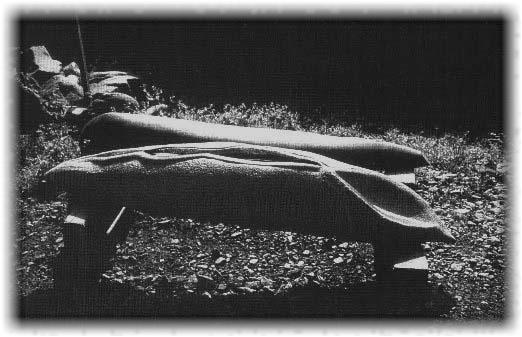
1991 granite
Snow, a Plum Tree, and the Joy of a Good
Chunk Falling Off
This morning at the Ongata
studio, winter still seemed reluctant to leave.
Snow from the previous day stubbornly clung to the
ground as if to say,
“Spring? I haven’t heard
anything about that.”
My workspace is beneath an old plum tree on the
north side of the studio.
It’s a wonderful spot. In spring, bush warblers
arrive and provide the soundtrack for the day.
In summer, the leaves form a natural sunshade.
It’s such a pleasant place that I sometimes feel I
ought to pay rent for it.
Winter, however, is another story.
Around noon, a little sunlight finally reaches the
spot,
only to disappear almost
immediately,
as if it had stopped by
merely to say hello.
Then I am left alone with the north wind blowing
straight at me.
After an hour of carving stone, my hands and feet
lose all sensation.
Strangely enough, though, my mind becomes sharper.
Old memories come back as easily as pulling books
from a shelf,
and my thoughts seem
unusually orderly and clear.
While the rest of me is
half frozen, my brain appears to switch into high-performance mode.
Human beings are curious creatures.
So neither snow nor cold weather really interferes
with my work.
Today, as usual, I spent the day tapping away at
stone:
*tok,
tok, tok.*
Before I knew it, evening had arrived.
The stone I am currently carving is a piece of
volcanic rock from Mt.
Yatsugatake,
which I picked up years ago from a riverbank in Kobuchizawa.
Back then it was simply a stone.
These days it spends its life being struck
repeatedly with hammers.
If stones have opinions, this one may feel it was
misled.
Many stone Buddhas around
the Yatsugatake region were carved from the same type
of rock.
Apparently, there was something of a stone-Buddha
boom during the Edo period.
Villages competed with one another to create stone
images, shrines, and roadside guardian deities.
It must have been the social media craze of its
day.
At Kaiganji Temple, many
outstanding stone Buddhas carved by the
Edo-period master sculptor Sadaji Moriya still remain.
His works possess not only technical excellence but
also a remarkable elegance
and dignity in their
expressions. It is no surprise that he still has devoted admirers today.
Using a similar stone, I am now carving Kotaro.
One of my favorite tools is called a *Koyasuke*—a delightfully friendly-sounding name.
It sounds less like a tool and more like a cheerful
neighbor who might stop by for tea.
In reality, however, it is a rather formidable
instrument:
a large hammer whose
striking end has been flattened into a broad edge.
I place the flat edge against the area I want to
remove and strike
it with an even larger
hammer.
When everything goes right—
**THUNK.**
A large section of stone breaks away and falls.
The satisfaction is difficult to describe.
It is not quite like winning a game, nor like
winning the lottery (not that I would know).
The stone seems to surrender all at once, and the
form I imagine becomes a little more visible.
For that moment alone, the cold wind and numb
fingers become insignificant.
So once again, beneath the old plum tree:
*tok,
tok, tok.*
And every now and then—
**THUNK.**
A satisfying chunk of stone falls away.
There are few pleasures quite like it.
---