Gallery Maki
JUN. 1988
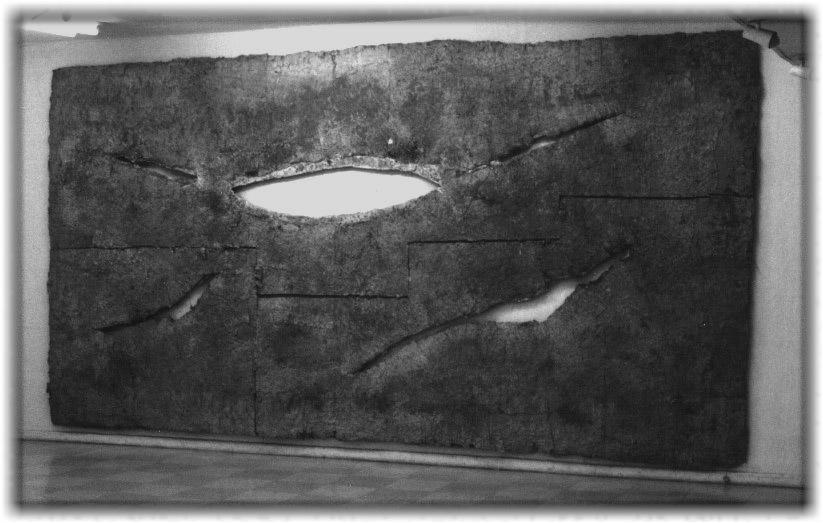
material paper
250x500x12cm
### The Gallery in Kanda
I would remain connected to that gallery in Kanda for twenty-one years.
I first visited it in 1981, when I was still a student.
It was a white-walled space—fairly large, though with a low ceiling.
As I was about to leave after quietly viewing the works, a woman called out to me:
“Please visit Tamura Gallery as well.”
As I asked for directions, a man appeared from somewhere.
He wore sandals and
shorts, had a bit of stubble, and a protruding belly.
He stood there humming to himself.
“We’re opening a solo exhibition by a
foreign artist,” he said politely.
“If you have time, would you like to come?”
I told him I had no money, but plenty of time.
“Then just follow him—you’ll be fine. It’s very close,” the woman said.
So I went along.
We walked through the still somewhat old-fashioned streets of Kanda,
I trailing behind a man about the same age as my father.
After about 200 meters, we climbed the stairs of an old building facing the street.
There was a glass door, slightly unusual, just wide enough for one person.
In gold lettering, it read: “Tamura Gallery.”
Beyond it lay a white, high-ceilinged space—detached from the ordinary world.
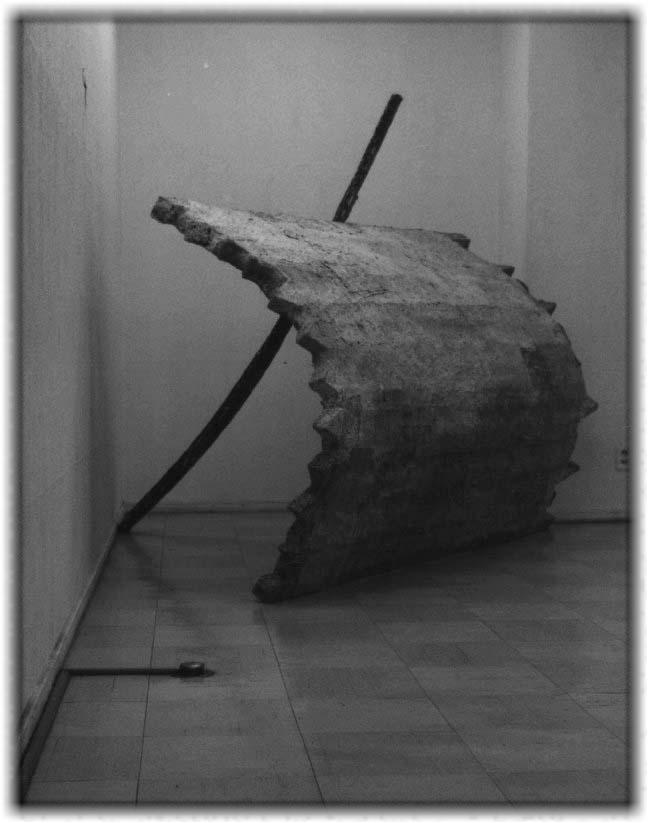
1988 Solo Exhibition Maki Gallery
Kyuichi Sato Exhibition (Until June 26th, 1988, Nihonbashi Honcho , Maki Gallery)
How much mass can you create a space from a thin material such as paper?
The artist who is fighting this problem announced a powerful work full of force.
Using kraft paper as a support, magazines are stacked on four layers,
five layers and the front and back, glued, and countless fasteners are embedded on the entire surface.
As the work continued while lying on the ground, soil grains, stones and pieces of wood
adhered to the surface, and an unexpected Machere was born.
The irregular holes cut into the screen imply the thickness of the space created by the materials.
The hidden back side shows up in another two-dimensional work made by
laminating twenty four sheets of Japanese paper transferred with blue pigment.
The similarities and differences between the front and the back
also make it possible to convey the expansion of the space vividly.
There are also curved semi-solids that use wood together.